
Guest article: Caitlin Roxburgh, The BD Consultancy
For marketing and business development (BD) teams in professional firms, the question is not whether to use artificial intelligence (AI), it is how to use it well and authentically alongside emotional intelligence (EI).
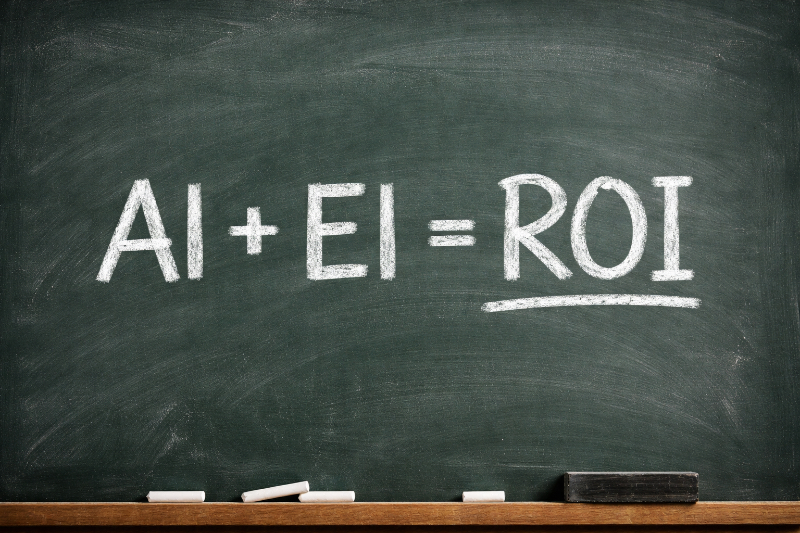
The BD Consultancy recently held a roundtable in central London bringing together senior marketing and BD leaders from major UK and global firms to weigh up a challenging equation: AI + EI = ROI
The conversation, opened by The BD Consultancy’s founder Peter Kane, centred on how firms are getting this balance right.
In the new age of AI, there has been a scramble to adopt new technologies, or risk being left behind.
However, it isn’t that simple. In BD and marketing, we are constantly reminded how important EI is when building authentic relationships and ultimately growth. Therefore, harnessing both AI and EI is paramount to a firm’s long-term success.
AI is powerful. But it is not complete.
Around The BD Consultancy’s table, there was no doubt that AI offers extraordinary potential for BD and marketing teams. It can accelerate research, support drafting, enhance analysis and free up time. It promises efficiency gains in environments where time is relentlessly scarce.
However, several leaders shared how some of their clients are expecting cost reductions from firms using AI. This means firms are either having to provide more for clients at the same cost, or risk delivering the same amount of work but at a reduced cost.
What is less visible across professional firms is the additional layer of training, supervision and quality control required to deploy AI responsibly within a regulated professional environment.
In many cases, the time saved on execution is offset by the time invested in testing, training and sense checking AI outputs. This discussion reaffirmed that whilst AI may create capacity, it does not remove accountability which is only possible through EI.
Partner fluency
Another theme that came out of the roundtable was the idea of partner fluency.
If partners are not confident explaining how AI is used and where it adds value, firms risk undermining trust at the very moment clients are asking more questions.
Firms that treat AI as a technical upgrade rather than a strategic narrative may find themselves exposed.
Headcounts are safe, for now
Interestingly, the discussion challenged the simplistic assumption that AI automatically reduces headcount, and several firms are finding the opposite. In fact, to run robust tests and train teams on new systems, firms are needing to invest both cost and human resource.
One delegate made the point that AI can allow us to “Do more with what we have, rather than the same with less.” Some firms are seeing that, with the adoption of AI, they need more people, not less, to maximise its impact over the long term.
The emotional impact
The pace of AI development has introduced uncertainty and, for some, genuine anxiety. Leaders who ignore that emotional impact risk eroding morale and trust internally, even as they pursue efficiency solutions.
Externally, a human touch also matters. AI-generated copy can feel technically competent, yet it lacks personality and empathy. This can make clients lose trust as you cannot build loyalty on efficiency alone. And this genuine sense of connection is particularly important when it comes to effective BD and marketing functions.
The real equation
AI is an extraordinary tool. But it is just that, a tool. Across firms, ROI will not come from automation alone. Good AI output requires good human input and scrutiny, so it is important to embed this all within and throughout your policy and governance frameworks. By combining the efficiency of AI with a human touch, firms can strike the right balance.
Caitlin Roxburgh is the Director of Marketing, BD and Responsible Business at The BD Consultancy.